26.03.2026 – 11.05.2026
Nuuk (Greenland) – Reykjavik (Iceland)
2nd Weekly Report (30.03.2026 – 05.04.2026)
We are now in our second week at sea on board the FS Maria S. Merian as part of Expedition MSM142. After a challenging start marked by harsh weather conditions, research activities are now fully underway and progressing smoothly and successfully. This is a testament to the remarkable commitment of the ship’s crew, as well as the scientific and technical teams, who are working closely together to make the most of every available window of favourable weather.
We have been continuously monitoring near–real-time satellite data, including sea surface temperature, sea surface height, and surface chlorophyll, to identify small-scale features that are suitable targets for our process study (SEA-Bloom). This effort involves daily discussions to evaluate potential sites, while also considering operational constraints such as weather conditions, instrument recovery locations, and the scientific relevance in the context of the prevailing oceanographic conditions.
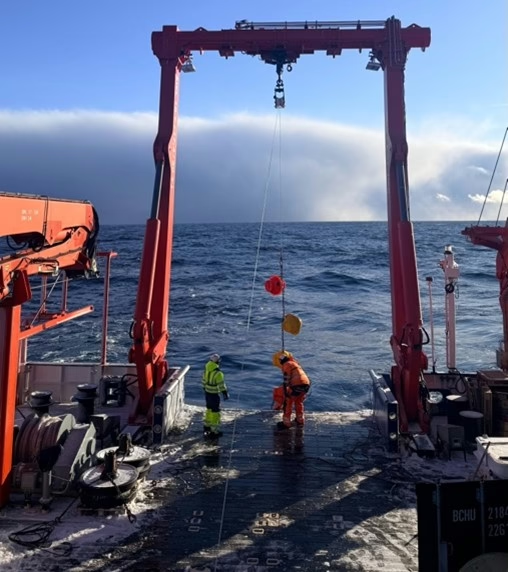
Figure 1: Recovery of DSOW4 during a glimpse of sunshine. (Photo: Fehmi Dilmahamod)
While steaming south towards the mooring locations, we conducted several transects across a potential eddy target, allowing us to obtain a first estimate of its velocity structure. From these measurements, we identified the feature as an anticyclonic eddy with a radius of approximately 12 km. Following the mooring operations, we carried out two high-resolution CTD transects across the eddy to characterise its vertical structure in temperature, salinity, oxygen, and chlorophyll. These observations confirmed that the feature is an Irminger Ring, characterised by a core of warm and saline water. Based on these findings and subsequent discussions among the scientific teams, we selected this eddy as the focus of our process study.
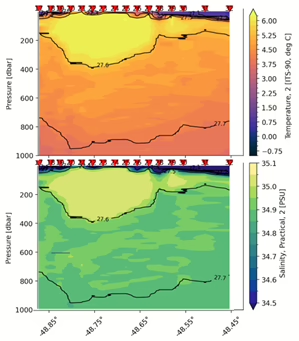
Figure 2: Uncalibrated (upper) temperature and (lower) salinity section through the eddy from high-resolutions CTD stations (triangles on top) (Figure: Marco Schulz)
We are currently navigating another period of harsh weather conditions. After completing two CTD stations, the chief scientist, in coordination with the bridge, decided to suspend operations due to the strong winds. We are now transiting towards the K1 mooring, located in the central Labrador Sea, which provides key observations of deep convection variability in the region. To make the most of this transit during unfavourable weather, we re-routed our track to pass over one seamount that has not been well mapped previously. Mapping these features contributes to the SEAMAP 2030 initiative, which aims to improve global knowledge of seafloor morphology through high-resolution mapping of seamounts.
We are planning to recover the 3700 m-long K1 mooring on Monday, April 6th at 06:00, when weather conditions are expected to improve. Following the recovery, we will proceed towards the 53°N Observatory to continue with further mooring recovery and deployment operations, as well as CTD sampling.
I would like to extend my sincere thanks to the ship’s crew and the technical team on board, who continue to work under extremely cold and icy conditions on deck, as well as to the bridge team for their careful coordination of glider and mooring operations. Today, Sunday, April 5th, is Easter, and we will take a moment this evening to share a meal together before resuming operations early tomorrow morning.
On behalf of all participants of RV Maria S Merian, best regards.
Fehmi Dilmahamod
Chief-scientist MSM142.